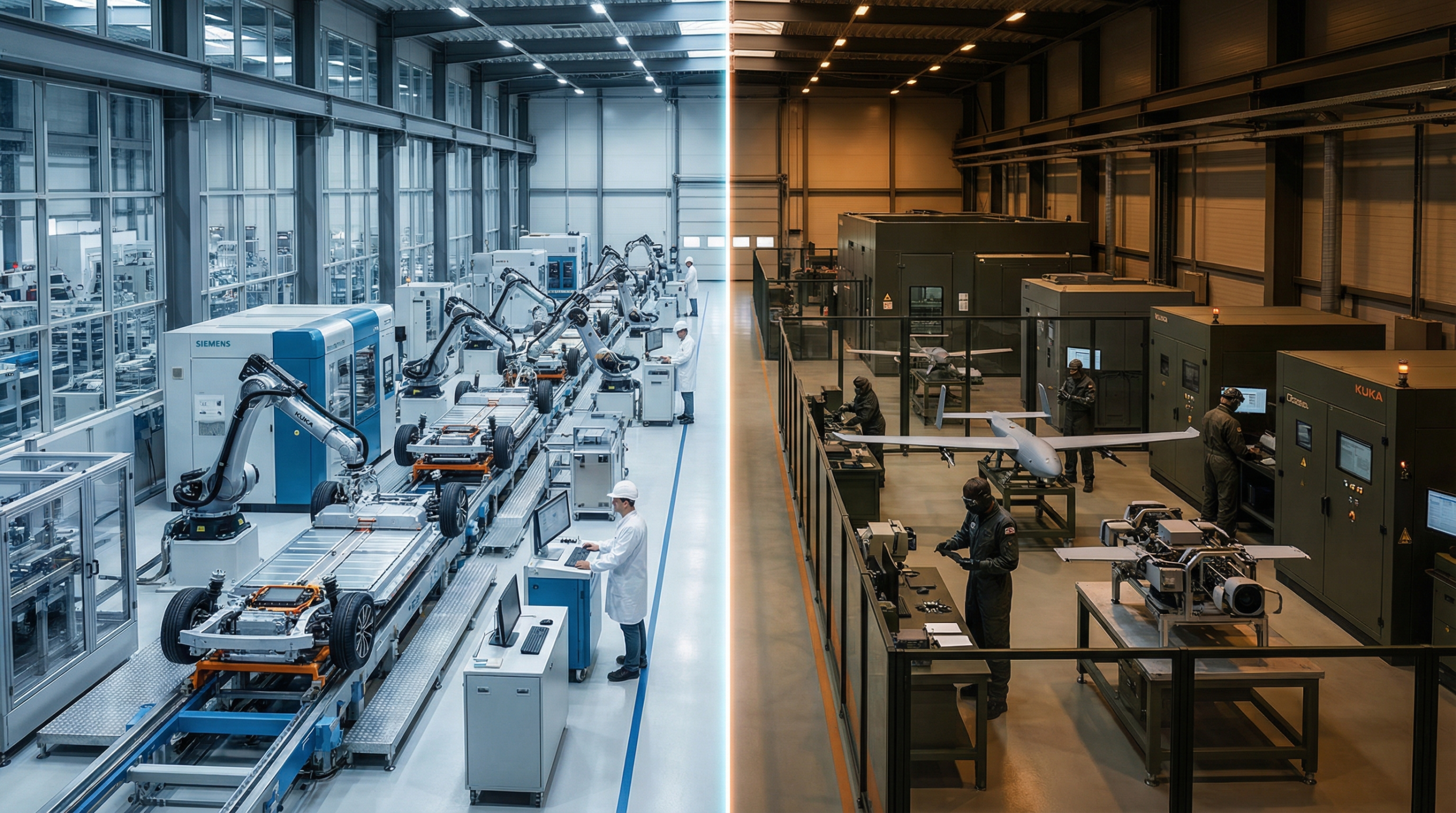
Even if the German automotive industry turned to the defense industry, it wouldn't catch up — but that's the wrong question
The German automotive industry can never make up for lost years by shifting to defense production. The numbers clearly show this. However, if we frame the question not in terms of revenue but in terms of profit, a very different picture emerges. The convergence of the two sectors is not a savior for the top line—but it could be one of the most tangible tools for stabilizing the bottom line in an industry where margins are bleeding spectacularly.
A wake-up call for the German auto industry: the numbers don't lie
Let’s start where most commentators stop—and where most mistakes are made.
The Volkswagen Group’s annual revenue exceeds 300 billion euros[1]. BMW’s is 133 billion euros[2]. Among the major Tier-1 suppliers, Bosch generates 90.5 billion euros[5] in revenue, while ZF generates 41.4 billion euros[4]. Overall, the German automotive industry’s exports amount to hundreds of billions of euros annually.
In contrast, what does the defense industry offer in terms of volume? Renault’s drone contract is for 10 years and is worth approximately 1 billion euros[7]. The much-discussed VW–Rafael partnership in Osnabrück is also a project worth several billion euros[7]. Total German defense exports to the United States amounted to $3.32 billion in 2024[9].
The difference in scale between the sectors is staggering. If, due to the collapse of the Chinese market, a corporation loses out on selling half a million electric cars priced at 50,000 euros each—a loss of 25 billion euros on its own—you can’t plug that hole with missile launchers. From a top-line perspective, the defense industry is not the solution. The European defense market—including the €800 billion budget of the ReArm Europe program[10]—is on a different scale than the mass consumer market on which the German automotive industry has been built over the past 30 years.
The other side: where the defense industry really outperforms the automotive industry
But now comes the figure that most analyses fail to mention.
Rheinmetall’s Weapons and Ammunition Division posted an EBIT margin of 28.4 percent in 2024, while the Group’s overall operating margin reached 15.2 percent—a historic high[6].
In contrast, where does the automotive industry stand? The Volkswagen Group’s operating profit in 2025 plummeted by 53.5 percent to 8.9 billion euros—the lowest figure since Dieselgate[1]. Bosch’s operating EBIT margin was 3.5 percent in 2024, down from 5.3 percent in 2023[5]. ZF’s adjusted EBIT margin was 3.6 percent—while it posted a net loss of €1.02 billion[4]. Audi’s operating margin fell to 6 percent[3].
The math is simple: 1 billion euros in defense revenue generates 150–200 million euros in net operating profit at current defense industry margins[6]. Achieving the same in automotive manufacturing, given the current margin environment of 3–4 percent, would require €5–6 billion in sales—in a market where Chinese manufacturers are waging a price war and the transition to EVs is consuming billions.
This asymmetry is the real story. It’s not that the defense industry is regaining its lost market share—because it isn’t. Rather, it’s that even with low volumes, it generates disproportionately high profits, and in an industry losing capital, this isn’t a theoretical issue—it’s a matter of survival.
Why is the digital transformation and shift in direction of German industry logical?
From a technological standpoint, this convergence is no coincidence. Over the past decade, the European automotive industry has invested a massive amount—€42 billion annually in R&D[8]—in sensor fusion, LIDAR, computer vision, and autonomous systems. These same technologies also form the basis of modern military drones and smart munitions.
There’s no need to rewrite the code from scratch—just port it to a different platform and reposition it for a market where the government is the buyer, the margin is three times higher, and the order backlog spans decades.
What lies ahead: the hell of enforcement
The strategic direction makes sense, and the financial arguments are compelling—yet it would be naive to think that the transition will go smoothly.
In the defense sector, even the production of the simplest component requires months of security vetting, MIL-SPEC quality standards, and a dedicated IT infrastructure. According to the talks in Osnabrück, the conversion could in principle be implemented within 12–18 months—but it cannot proceed without the individual approval of the employees[7].
Physically retooling production lines requires a significant one-time capital investment. The differences between civilian and military specifications—material quality, ballistic tolerances, and service life requirements—are not insurmountable, but they are by no means trivial.
And then there is the brand risk. This is particularly true in Germany, where pacifism is deeply rooted in society. A VW spokesperson immediately stated: “Weapons production by Volkswagen AG is out of the question”—even though negotiations regarding non-missile components are clearly underway[7]. Communicating the transition is one of the most delicate management tasks—and that alone is reason enough for many companies to move slowly.
Sources
- Volkswagen Group: Annual Report & Full-Year Results 2024/2025 — volkswagen-group.com
- BMW Group Report 2024 — bmwgroup.com
- Audi AG: Financial Results for 2024 — audi-mediacenter.com
- ZF Friedrichshafen: Financial Reports 2024 — zf.com
- Bosch Group Annual Report 2024 — bosch.com
- Rheinmetall: Financial Results for Fiscal Year 2024 — rheinmetall.com
- Defense News: Volkswagen in talks to manufacture Iron Dome components at a struggling German auto plant, March 26, 2026 — defensenews.com
- PwC / Strategy&: Analysis of European Automotive R&D Spending — pwc.com
- IW Köln — Thomas Puls: The German Automotive Sector in Structural Transition, 2024 — iwkoeln.de
- European Commission: ReArm Europe / Readiness 2030 — commission.europa.eu
Frequently Asked Questions (FAQ)
Why is the transformation of the German automotive industry important for the Hungarian IT sector?
A significant portion of Hungarian IT service providers’ revenue comes from automotive suppliers in the DACH region. If the German automotive industry undergoes a transformation—whether toward the defense industry or electric mobility—it will require new capabilities from the Hungarian IT sector.
What kind of AI solutions does the German Mittelstand need?
German medium-sized companies are primarily looking for process automation, predictive maintenance, and supply chain optimization. Demand for AI consulting is steadily growing in Germany.
How is digital transformation affecting industry in the DACH region?
Industrial companies in the DACH region are increasing their digital transformation budgets by 5–15% annually. AI and automation are the fastest-growing areas of investment—and this presents a direct opportunity for Hungarian IT service providers.
Related articles
- The future of IT workers may hinge on the outcome of a $600 billion industry-wide issue — The DACH labor market paradox: 109,000 unfilled IT positions in Germany, even as layoffs are taking place
- We no longer build chatbots—we build a digital workforce —A strategy for porting automotive sensor technologies to AI