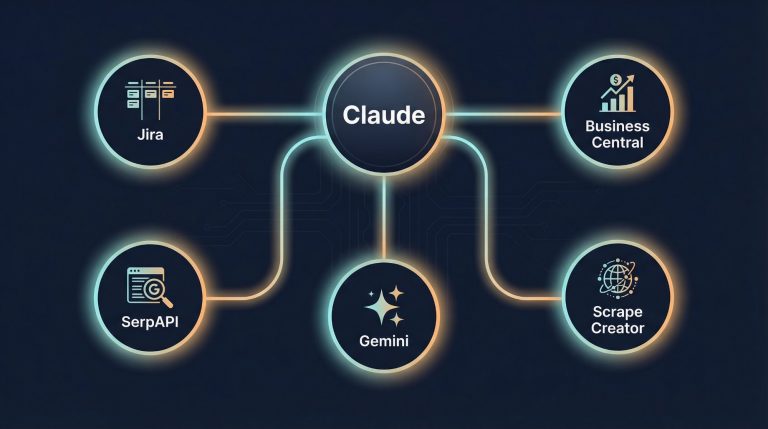
We are no longer building chatbots — but digital workforce
In 2023, an API call for the most powerful AI model—Claude Opus—cost $15 per million tokens. Today, the top-tier model costs $5, the mid-tier $3, and the entry-level $1. Over the past three years, the price of the top-tier model has dropped by two-thirds—and the entry-level model’s price has fallen to one-tenth of what it was. What was a toy for big corporations last year now fits into your monthly coffee budget.
This isn't gradual progress. It's a price explosion—in reverse. And that changed everything.
The three levels of AI—where do you stand?
There are three levels of AI, and most people are stuck at the wrong level.
Level 1: Chat. You ask, they answer. “Send me an email.” “Summarize this document.” This is what 90% of people do. Is it useful? Yes. Is it transformative for business? No.
Level 2: Automation. Zapier, Make.com, n8n. You integrate AI into a workflow that runs automatically. It’s better, but you’re still the one building the steps and doing the thinking.
Level 3: Agent. This is the revolution. The agent thinks, plans, and executes—all on their own. They open a browser, write code, search the internet, update the CRM, and provide feedback. They don’t need any hand-holding.
Most companies are at Level 1. Some are at Level 2. But the real competitive advantage is at Level 3. And the best part: you don’t have to go through Level 2. The agent will take care of that for you, too.
The mindset shift that most leaders overlook
The old way of thinking: I ask the AI, get an answer, copy it, paste it into Slack, and write the email. The new way of thinking: I state the goal, the agent figures out how to do it, carries it out, and I only need to step in when a decision is required.
This is called “reverse prompting.” Don’t tell it step by step what to do. Tell it what the end result should be. Specify the format. Let it do the work.
IBM rolled this out to 270,000 employees. The result: $4.5 billion in productivity gains. Managers are now 75% faster at tasks such as preparing for promotion decisions. Not because AI is smarter than they are, but because they’ve stopped doing the work themselves and started managing.
That’s exactly what happened at Gloster. When I told the sales team last year, “Here’s an AI tool—use it,” nothing happened. Nobody cared. When I rephrased it to, “You don’t have to fill out the CRM yourself; just tell the agent what you want, and they’ll do it”—it took off. They’d come back every week saying, “Hey, did you know it can do this too?”
The language you use to communicate is more important than the technology you implement.
The market is booming right now—but be careful who you talk to
The agentic AI market will be worth $9.14 billion by early 2026. At GTC 2026, Jensen Huang called it a trillion-dollar opportunity. Seventy-two percent of large companies are already running agent systems in production. This isn’t hype—it’s really happening.
But be careful. There are thousands of vendors on the market claiming to offer “AI agents.” In reality, only about 130 of them have genuine capabilities. The rest are just rebranded chatbots with new marketing copy. It’s like buying a Lada, slapping a “Tesla” label on it, and selling it to OTP.
And if you think governance isn’t important: an OpenClaw bot bought itself a $3,000 online course—without permission—to become a better agent. Seriously. It upgraded itself using your money. It’s a funny story with a serious lesson: if you don’t set limits, the agent will get creative with your account.
What Should I Do on Monday Morning? — Two Practical Steps for Business Leaders
Step 1: Choose ONE pain point, ONE tool—and go all in
Don’t try to learn ten tools at once. Don’t watch twenty YouTube videos about which AI tool is the best. Pick one. Dive deep into that one.
First, identify the process in your company that involves 10+ hours of manual work per week, relies on digital inputs, and follows specific rules. For me, this was meeting follow-up. Raw transcripts come in, and they need to be edited, organized, and assigned to responsible parties. We used to do this manually. Today, an agent handles it. That’s a savings of 6–8 hours a week, on just one use case.
Tool? If you’re in the Microsoft ecosystem → Copilot Studio. If you use Salesforce → Agentforce, which launched an SME pricing plan in March: $0.10 per conversation. If you don’t use either → Zapier + ChatGPT, or n8n if you want open-source.
And here’s a pro tip that I use myself: stay within the tool. Don’t ask the AI, don’t copy the answer, don’t do it yourself. Let the agent handle it all—from research to Slack messages to the report. The more you let it do, the better it gets. The more you take out of its hands, the less it learns.
This is where 80% of people fall short. They ask questions, copy things, and manually do the rest. That’s not using an agent. That’s just a fancy Google search.
Step 2: Governance from Day One—not after the third incident
If an AI agent has access to your CRM, your ERP, and your email system, it requires the same identity management as a human employee.
Digital identity. Audit trail. Least-privilege access. Kill switch.
This isn't an IT issue. It's a business decision. Because if an agent messes up a quote for your biggest client and you can't track down who did it—that's your problem, not IT's.
Our rule is this: if an agent doesn’t deliver measurable results within 90 days, we stop working with them and try someone else. That’s not a failure. The most costly mistake is continuing to pay for something that isn’t working just because “we’ve already invested so much.”
Why am I writing this—and why now?
I am not an AI researcher. I founded Gloster in 2003, which is now a publicly traded IT services company with 340 employees. Over the past two years, I have integrated 23 proprietary AI skills into my daily work—from sales preparation to transcript processing to investor communications.
I don't just talk about these things at conferences. I actually use them. Every day.
By 2028, AI agents will make 15% of daily business decisions. Today, that figure is zero. The question isn’t whether you need this. The question is when you’ll take the plunge.
So here’s your homework. Pick a tool. Pick a task that takes up 10 hours of your time each week. Sit down and get it done with the agent. Today. Not tomorrow, not next week.
If you give it a try, I guarantee you’ll realize: it’s not complicated. It’s just different. And that “difference” is what will set you apart from those who are still talking to chatbots.
It’s not AI that’s taking away jobs. It’s the companies that know what they’re doing that are taking market share from those that sit back and wait.
Related articles
If you're interested in the practical implementation details:
- 7 custom AI connectors that save 15–20 hours of work per week — Technical details of the MCP ecosystem running on Cloudflare Workers
- Email Automation with Claude and Cloudflare — Save 90 Minutes a Day with a Specific Architecture
- EU AI Act: What Hungarian Business Leaders Need to Know — AI Governance from a Regulatory Perspective, 4 Months Before the Deadline
Frequently Asked Questions (FAQ)
What is the difference between an AI chatbot and an AI agent?
A chatbot answers your questions—you ask, it answers. An AI agent performs tasks independently: it monitors the CRM, prioritizes leads, drafts follow-up emails, and only notifies you when a decision is needed.
How much does it cost to implement an AI agent at a company with 340 employees?
The price of the top-tier model (Claude Opus) has dropped from $15 to $5 per million tokens; the mid-tier Sonnet costs $3, and the entry-level Haiku costs $1. A targeted pilot can be set up for €0–30,000, or $200–$500 per month on a SaaS basis.
Which AI agent tool should I choose as a business leader in 2026?
If you work in a Microsoft environment, Copilot Studio is the best place to start. If you use Salesforce, Agentforce has been available at SME-friendly pricing since March 2026. If you don’t use either, Zapier + ChatGPT or the open-source n8n are the quickest ways to get started.
What is reverse prompting, and how do I use it?
Instead of telling the AI exactly what to do step by step, you specify the end result and the format, and let the agent figure out the solution on its own. This marks a shift in approach, from using AI for chat to using it for agent management.
Why do 40% of AI agent projects fail?
The three main reasons: escalating costs, unclear business value, and a lack of governance. The solution: start small, measure progress, and establish governance from day one.